Before I get into how life has been for me during the many weeks that have elapsed since my last few feeble posts, let me make you a promise that I will try to get a more substantial post up in the next week or so and apologize (though without any guilt whatsoever--it couldn't have been helped!) that I have not been posting regularly.
The latest update from our Ghana cohort, a sketch of our life in the village of Oguaa written by Kathleen Ryan, one of the five of us in Ghana, is available here, if you care to peruse and get a better picture of our daily life in there. Now that I am sharing it with you, though, it is a bit outdated; on April 17, we moved from Oguaa to Kumasi, Ghana's 2nd largest city, where we have begun working at orphanages and creches (nursery schools). It is good to be back among some of the more familiar things in life--I missed my commute to work by tro-tro, and internet access is more convenient now--but I miss Oguaa and its people. I miss Nana, the grandfatherly chief whose constant refrain is "Come and chop!" (Come and eat!) and "Afriyie, wodaa yie?" (Jessica, did you sleep well?). I miss Sewaa, the chief's sister and constant presence in my daily life who makes me wish only to be that energetic, caring, and lively in my old age; her tears of goodbye triggered mine when she wept, "Yerenfere mo; nrefere yen." (We will never forget you; do not forget us.) I miss Akwasi, my 14-year-old (or 9-year-old, depending on who you ask) friend whom I would help every night with his homework and who would sometimes bring me mangoes or call me to check in when we went on trips, and who still calls me almost every day. I miss Malia, my 4-year-old host sister, who would come grab my hand and say my Twi name, "Akua!" when I emerged early each morning from my room. These are people I will never forget.
And yet, as I said, life has moved on, and now I am getting to know Nana Amma, my 32-year-old host sister, her 18-month-old son Kofi, and her mother Ma Afia and my new route to work at Swift Montessori (catch a car to Kotei, then from there take one to Tech Jct, where cars are waiting for passengers like me who are going to Anwomaso). But more on this later! For now best wishes as we close out April, and greetings to all!
Wednesday, April 21, 2010

Monday, March 22, 2010
Still Doing Well
Just checking in... Internet time has been ever scantier, but let me assure you that God continues to bless me and pass on a few links:
*A Princeton article: http://www.princeton.edu/main/news/archive/S26/76/33K78/index.xml?section=featured
*Nick's "Update from the Field" for February: http://www.princeton.edu/bridgeyear/updates/archives/?id=2649
Life is good! I am looking forward to sharing more when I return to the United States, but I am enjoying every day for the next two and a half months in the meantime to the fullest!
Love,
Jessica
*A Princeton article: http://www.princeton.edu/main/news/archive/S26/76/33K78/index.xml?section=featured
*Nick's "Update from the Field" for February: http://www.princeton.edu/bridgeyear/updates/archives/?id=2649
Life is good! I am looking forward to sharing more when I return to the United States, but I am enjoying every day for the next two and a half months in the meantime to the fullest!
Love,
Jessica
Saturday, February 27, 2010
We don't need blankets in Ghana, but we need to wrap ourselves in prayer
Thanks to all of you who have interceded for me and the other four students in prayer over the last 6 months. I only have a couple of minutes at this internet cafe, so I can't say much, but suffice it to say that although living here continues to be a blessing and I thank God every day for having brought me to Ghana, I am experiencing a lot of spiritual growth here too, and it is not always easy. Part of that growth is a deeper understanding of God's hand in the world as He manifests Himself through the Holy Spirit, who I am getting to know better after having attended a Pentecostal church each Sunday in Accra and now talking to people in the village who have a much different concept of the Spirit's presence in life. In contrast, I have met priests and priestesses (there are about four or five being trained in our village) and seen them go into trances, wildly dancing at festivals.
So I believe that spiritual warfare exists on a much more real plane that I ever understood back in America. Because of this, I now realize how absolutely vital your prayers over me are. In Ghana, I am outside my usual circle of faith--my community and family of believers. Here, I regularly go to church and actually read the Bible and pray more frequently than I used to, but I still plead with you to lift me and the rest of the group before God frequently. Please pray for spiritual fortitude for us, for protection against evil, and for the joy and strength of the Lord in all that we do.
I wish I could give you a longer exposition, but know that it is well with my soul, for I am resting in the Lord. I pray for you, and I simply ask that, although the distance separating us is great, so is the power of the Father, His Son, and His Spirit, and so let us pray for each other as brothers and sisters.
Love in Christ,
Jessica
P.S. A few pictures...
So I believe that spiritual warfare exists on a much more real plane that I ever understood back in America. Because of this, I now realize how absolutely vital your prayers over me are. In Ghana, I am outside my usual circle of faith--my community and family of believers. Here, I regularly go to church and actually read the Bible and pray more frequently than I used to, but I still plead with you to lift me and the rest of the group before God frequently. Please pray for spiritual fortitude for us, for protection against evil, and for the joy and strength of the Lord in all that we do.
I wish I could give you a longer exposition, but know that it is well with my soul, for I am resting in the Lord. I pray for you, and I simply ask that, although the distance separating us is great, so is the power of the Father, His Son, and His Spirit, and so let us pray for each other as brothers and sisters.
Love in Christ,
Jessica
P.S. A few pictures...
Saturday, February 20, 2010
A View of Transition and Life Beyond
As of today, I have been living in Oguaa, a small village of perhaps three to four hundred people, for 40 days—and though they have not been without challenges, these 40 days have been remarkably joyful. So many things here are so different from my past experiences (both in the US and in Accra), but I think the most noteworthy is the fact that I have stopped noticing many of them. Things that once may have surprised or shocked me are normal, and one-time nuisances have come to be just what I need to brighten my days. Life in Oguaa is good.
I won't give you an extensive recounting of our journey from Accra to Oguaa via Kumasi, Ghana's second largest city and the nearest place (at about 2 hours away) where I can find reliable internet access. Each month one of the five of us Bridge Year students writes an update from the field and submits it to Princeton for publication on their website, and so when my opportunity to write the update came in January, I chose to write about our transition. You can find my report here (and roam the site to find the archived updates written by Nick, Kathleen, Cole, and Aria) if you want to fill in some of the gap between my last blog post and the previous ones.
But for the most part, as I alluded to, the transition is over, replaced by living. No longer do the not-uncommon power outages seem terribly inconvenient; as long as my phone has enough battery to last until the power comes back on in a few hours, I have come to enjoy the respite from the constant background din of peoples' radios that a “lights off” brings. The surprisingly terrifying grunts and bays of the fattened ram who is tied up nearby are now more apt to make me shake my head as I bid him goodnight than to make the hair on the back of my neck bolt upright. Many times a day when a child stares after me as I pass, singing out, “Oboruni kכkכ, maakye!” (“White person/foreigner, good morning!”) at any time of the day, I answer quickly with a little dance and a sing-song call—“Yaa, fikyiri gon-gon!” (the expected gibberish response)—rather than bewilderment at why kids are wishing me good morning at 4:00 in the afternoon. All of this is just part of how I live.
In short, the details of how I live are thus: I stay in a house which is basically one row or bank of rooms (a toilet room, bathing room, kitchen, and chicken coop) opposite a small, empty, cement “courtyard” from another bank of rooms, which shaped like a block-lettered “C”. Basically, my house is a square, but one side of the square is not connected to the others, and in the middle of the square is an open area which is flat and cemented. Each of the rooms has door that opens onto this “courtyard.” My house is not occupied by a single family; rather, there is the elder of the house, who is called “כpanin” (“Elder”), an old woman and her two young granddaughters (Sekina and Malia), who have become the equivalent of my host family under these odd living circumstances, and two teachers (Owusu and Akwasi Edward) in their early twenties.
Because I don't quite live with a host family (I am more like the other two teachers, who are renting the rooms, than an exchange student living with and learning from a family as a temporary member), I spend a lot of my time with Aria, Nick, Kathleen, and Cole at our Bridge Year headquarters, located in the village chief's house. Like me, Cole and Kathleen stay in houses in the village, while Aria and Nick have rooms in the chief's house, which is a compound similar to mine. However, when we are not sleeping or spending time in our rooms or with the other residents of our houses, we tend to gather at Nana's place, as we know headquarters. Whether cooking our communal meals, doing the dishes, or just hanging out, simply spending time together has helped me to develop friendships that I really value with each of the other four students. To be honest, it has been a struggle at times to adjust to the new living circumstances after my wonderful host family in Accra, and I sometimes feel that I should spend more time at my house than Nana's place, but I am learning to divide my time well and look forward to continuing spending time with the best friends I have in Ghana.
In terms of work, I am teaching at a middle school called Seniagya Methodist Junior High School, located in a village about a ten minute walk from Oguaa. In the school—a fairly new building comprised of three classrooms and an office—there are three “forms” equivalent to 6th, 7th, and 8th grades with about 25 students in each form. Initially I expected that I would be assisting teachers and tutoring and generally trying to be helpful, but I am in fact the form 1 (6th grade) math teacher. This means that if you need any help calculating a fraction's lowest terms or talking about the relationship between a plane shape like a circle and the net of a solid such as a cylinder, I am the person to come to, particularly if you would like a faltering explanation in Twi! I teach my 25 students, who range in age from 12 to 19, four times a week for about 70 minutes if the school is running on schedule (or about 60 minutes if it is a typical day) using a mix of a little English and as much Twi as I can muster. No class ever goes quite as expected according to the lesson plans I write, but I am proud to say that my students know the difference between a ray and a line, and I am pretty confident that I know all their names. Never could I have guessed how simply rewarding and mind-blowingly frustrating teaching can be and is—but my name is now Madam.
To distill these details, this life is unlike anything I have experienced before, including life in Accra—but as I stared in wonder at the magnificent, sizzling purple thunder tearing through the resolute black sky two nights ago, I realized I don't want to live any other life right now.
I won't give you an extensive recounting of our journey from Accra to Oguaa via Kumasi, Ghana's second largest city and the nearest place (at about 2 hours away) where I can find reliable internet access. Each month one of the five of us Bridge Year students writes an update from the field and submits it to Princeton for publication on their website, and so when my opportunity to write the update came in January, I chose to write about our transition. You can find my report here (and roam the site to find the archived updates written by Nick, Kathleen, Cole, and Aria) if you want to fill in some of the gap between my last blog post and the previous ones.
But for the most part, as I alluded to, the transition is over, replaced by living. No longer do the not-uncommon power outages seem terribly inconvenient; as long as my phone has enough battery to last until the power comes back on in a few hours, I have come to enjoy the respite from the constant background din of peoples' radios that a “lights off” brings. The surprisingly terrifying grunts and bays of the fattened ram who is tied up nearby are now more apt to make me shake my head as I bid him goodnight than to make the hair on the back of my neck bolt upright. Many times a day when a child stares after me as I pass, singing out, “Oboruni kכkכ, maakye!” (“White person/foreigner, good morning!”) at any time of the day, I answer quickly with a little dance and a sing-song call—“Yaa, fikyiri gon-gon!” (the expected gibberish response)—rather than bewilderment at why kids are wishing me good morning at 4:00 in the afternoon. All of this is just part of how I live.
In short, the details of how I live are thus: I stay in a house which is basically one row or bank of rooms (a toilet room, bathing room, kitchen, and chicken coop) opposite a small, empty, cement “courtyard” from another bank of rooms, which shaped like a block-lettered “C”. Basically, my house is a square, but one side of the square is not connected to the others, and in the middle of the square is an open area which is flat and cemented. Each of the rooms has door that opens onto this “courtyard.” My house is not occupied by a single family; rather, there is the elder of the house, who is called “כpanin” (“Elder”), an old woman and her two young granddaughters (Sekina and Malia), who have become the equivalent of my host family under these odd living circumstances, and two teachers (Owusu and Akwasi Edward) in their early twenties.
Because I don't quite live with a host family (I am more like the other two teachers, who are renting the rooms, than an exchange student living with and learning from a family as a temporary member), I spend a lot of my time with Aria, Nick, Kathleen, and Cole at our Bridge Year headquarters, located in the village chief's house. Like me, Cole and Kathleen stay in houses in the village, while Aria and Nick have rooms in the chief's house, which is a compound similar to mine. However, when we are not sleeping or spending time in our rooms or with the other residents of our houses, we tend to gather at Nana's place, as we know headquarters. Whether cooking our communal meals, doing the dishes, or just hanging out, simply spending time together has helped me to develop friendships that I really value with each of the other four students. To be honest, it has been a struggle at times to adjust to the new living circumstances after my wonderful host family in Accra, and I sometimes feel that I should spend more time at my house than Nana's place, but I am learning to divide my time well and look forward to continuing spending time with the best friends I have in Ghana.
In terms of work, I am teaching at a middle school called Seniagya Methodist Junior High School, located in a village about a ten minute walk from Oguaa. In the school—a fairly new building comprised of three classrooms and an office—there are three “forms” equivalent to 6th, 7th, and 8th grades with about 25 students in each form. Initially I expected that I would be assisting teachers and tutoring and generally trying to be helpful, but I am in fact the form 1 (6th grade) math teacher. This means that if you need any help calculating a fraction's lowest terms or talking about the relationship between a plane shape like a circle and the net of a solid such as a cylinder, I am the person to come to, particularly if you would like a faltering explanation in Twi! I teach my 25 students, who range in age from 12 to 19, four times a week for about 70 minutes if the school is running on schedule (or about 60 minutes if it is a typical day) using a mix of a little English and as much Twi as I can muster. No class ever goes quite as expected according to the lesson plans I write, but I am proud to say that my students know the difference between a ray and a line, and I am pretty confident that I know all their names. Never could I have guessed how simply rewarding and mind-blowingly frustrating teaching can be and is—but my name is now Madam.
To distill these details, this life is unlike anything I have experienced before, including life in Accra—but as I stared in wonder at the magnificent, sizzling purple thunder tearing through the resolute black sky two nights ago, I realized I don't want to live any other life right now.
Saturday, January 30, 2010
Oguaa in the morning
I wake up in the morning only after much snooze button-fumbling within the confines of my mosquito net: Why is it only 5:30? Though it takes a burst of pure willpower, eventually I work up the energy to switch off my alarm, sit up, unzip my net, and slip through the opening, usually without falling onto the floor. As my bare feet scuffle across the smooth cement floor, I slip on my trusty Old Navy flip flops to avoid any of the friendly but intimidating spiders that may have ventured off the wall and onto the floor before grabbing my two yards of green and brown printed cloth, which I use to wrap around me in some kind of toga-esque style.
I unlock the door, take a few sheets of toilet paper for good measure, and shuffle across the courtyard of my compound to the bathroom. The small cement room contains a broom made from palm fronds, an empty plastic oil container, and a plastic seat embedded in the top of a hollow cement column--a welcoming sight. Exiting the bathroom, I shuffle back into my room by the light of a luminous moon and the bare flourescent lightbulb protruding from the exterior wall. I collect my towel, shampoo, bathing sponge (called "sapo," which is a rectangular piece of netting about 6 inches by 24 inches used to scrub oneself while bathing--the Ghanaian loofah), and tiny blue plastic pail before again venturing across the courtyard. A quick glance around helps me identify the two bathing buckets: one to dip into the huge barrel of water, and another to hold the water fetched with the first bucket. One, two, three times I submerge the smaller of the two buckets in the barrel, and one, two, three times the water splashes from one bucket into the other.
As I enter the stark bathing room, I hang my towel and cloth over the frail wooden door, and steel myself: the water scooped by the little pail will be cold, and the morning is not particularly warm either. Begin with the feet, because they require the most attention and scrubbing to remove the earthy-fine dust, and then proceed to pour a little water onto my chest to reduce the shock of drenching my hair in the morning chill. Scrub a little, pour on some water, and scrub some more. The bucket bath is neither complicated nor pretentious, but no matter the cold that creeps into my fingertips: this is the perfect beginning.
I greet my eight-year-old host sister, Sekina, as I notice her sitting on the cement step in a long, dusty, elegant skirt: "Sekina, maakye." "Yaa, ena," she replies, and we exchange a smile before I disappear into my room. Inside, the clothes from which I pick a simple outfit for the day are stuffed into an extra duffel bag I had brought along, for there is no need for the luxury of a dresser in my bare room; the bed stands independent and alone against shockingly vibrant blue walls.
So I am clothed, and I wriggle my feet into my trusty sandals before doing my mental survey of the morning. Remembering, I retreive my industrial-sized Walgreen's pharmacy bottle and select a particularly delicious-looking malarone (malaria prophylaxis) pill and swallow it with the aid of lukewarm water from a sachet. Now the morning is complete. I gather the essentials for a day of teaching 6th grade math--a black pen for writing lesson plans, a red pen for correcting exercises, a copy of the slim Pupil's Textbook for Mathematics, the Mathematics Syllabus for Junior High School, my flimsy lesson plan book, and a Ghc1 note in case some of the kids need to buy lunch--and a few necessities for life--sunscreen, some tissue, my cell phone. I open the door, exit, and turn the key firmly in the lock.
"Nana, mepaakyew, mereko sukuu. Onyame adom, yebehyia awia!"
Grandma, please, I am going to school. By God's grace, we shall meet this afternoon!
I unlock the door, take a few sheets of toilet paper for good measure, and shuffle across the courtyard of my compound to the bathroom. The small cement room contains a broom made from palm fronds, an empty plastic oil container, and a plastic seat embedded in the top of a hollow cement column--a welcoming sight. Exiting the bathroom, I shuffle back into my room by the light of a luminous moon and the bare flourescent lightbulb protruding from the exterior wall. I collect my towel, shampoo, bathing sponge (called "sapo," which is a rectangular piece of netting about 6 inches by 24 inches used to scrub oneself while bathing--the Ghanaian loofah), and tiny blue plastic pail before again venturing across the courtyard. A quick glance around helps me identify the two bathing buckets: one to dip into the huge barrel of water, and another to hold the water fetched with the first bucket. One, two, three times I submerge the smaller of the two buckets in the barrel, and one, two, three times the water splashes from one bucket into the other.
As I enter the stark bathing room, I hang my towel and cloth over the frail wooden door, and steel myself: the water scooped by the little pail will be cold, and the morning is not particularly warm either. Begin with the feet, because they require the most attention and scrubbing to remove the earthy-fine dust, and then proceed to pour a little water onto my chest to reduce the shock of drenching my hair in the morning chill. Scrub a little, pour on some water, and scrub some more. The bucket bath is neither complicated nor pretentious, but no matter the cold that creeps into my fingertips: this is the perfect beginning.
I greet my eight-year-old host sister, Sekina, as I notice her sitting on the cement step in a long, dusty, elegant skirt: "Sekina, maakye." "Yaa, ena," she replies, and we exchange a smile before I disappear into my room. Inside, the clothes from which I pick a simple outfit for the day are stuffed into an extra duffel bag I had brought along, for there is no need for the luxury of a dresser in my bare room; the bed stands independent and alone against shockingly vibrant blue walls.
So I am clothed, and I wriggle my feet into my trusty sandals before doing my mental survey of the morning. Remembering, I retreive my industrial-sized Walgreen's pharmacy bottle and select a particularly delicious-looking malarone (malaria prophylaxis) pill and swallow it with the aid of lukewarm water from a sachet. Now the morning is complete. I gather the essentials for a day of teaching 6th grade math--a black pen for writing lesson plans, a red pen for correcting exercises, a copy of the slim Pupil's Textbook for Mathematics, the Mathematics Syllabus for Junior High School, my flimsy lesson plan book, and a Ghc1 note in case some of the kids need to buy lunch--and a few necessities for life--sunscreen, some tissue, my cell phone. I open the door, exit, and turn the key firmly in the lock.
"Nana, mepaakyew, mereko sukuu. Onyame adom, yebehyia awia!"
Grandma, please, I am going to school. By God's grace, we shall meet this afternoon!
Tuesday, January 5, 2010
Goodbye to a second home
Tomorrow, tomorrow, I love you, tomorrow, it's only a day away!
I can scarcely believe that in 24 hours I will just be arriving in Kumasi to begin the second phase of my Ghanaian life. Please pray for safety and health for our group, a good adjustment, and a sense of purpose and community as we continue our volunteer work and cultural exploration. I thank God for your prayers and support throughout my time in Ghana!
After I arrive in the village where I will be living, it's unlikely that I will have frequent internet access (it will be much less convenient to get to an internet cafe) and so my blog postings will be less prolific. However, I promise not to forget to pop in to give you an update every once in a while! :)
Love to you all,
Jessica
I can scarcely believe that in 24 hours I will just be arriving in Kumasi to begin the second phase of my Ghanaian life. Please pray for safety and health for our group, a good adjustment, and a sense of purpose and community as we continue our volunteer work and cultural exploration. I thank God for your prayers and support throughout my time in Ghana!
After I arrive in the village where I will be living, it's unlikely that I will have frequent internet access (it will be much less convenient to get to an internet cafe) and so my blog postings will be less prolific. However, I promise not to forget to pop in to give you an update every once in a while! :)
Love to you all,
Jessica
Monday, January 4, 2010
Buronya (n):
(1) A holiday commemorating the birth of Jesus Christ and celebrated on 25 December. (2) Twi for "Christmas." (3) Literally translated, "foreigner" (oboruni) "receives" (nya), as in the foreigner is celebrating receiving something.
Buronya... These definitions are all accurate, but not in the least the whole picture of my Christmas with my host family in Adenta. So let me provide you with some other pictures to help you understand a bit better:
This is how I began my Christmas: with a miniature stocking to garnish my mosquito net! My wonderful parents sent me a Christmas package from America containing this stocking, presents for me and my host family, and a couple of more essentials: candy canes and Werther's toffees. They sent it on 20 November and it reached me just in time for Christmas on 21 December.

Usually my host family opens gifts together, they told me, but this year everyone was very busy and so I gave the presents out piecemeal since we didn't have anything like the Christmas Eve present extravaganza that usually takes place at my house in America. Often families in Ghana have a large meal on Christmas, with fresh chicken and cake and other delicacies, but my family feasted on the traditional dish of banku, which Cole describes well in the second half of this blog post. When my younger host brother Kwaku learned that Christmas had passed without this feast, his face fell and he announced, "Then I did not spend my Christmas well!" Cute though his response was, I found that the way we did spend Christmas, at a series of church services, was a nice respite from the consumerism and materialism that so often cloud the miracle of Jesus' incarnation on Christmas.

This is a snapshot of church one morning, with the ladies bedecked in their finest to come and worship with fervent prayer and joyful, energetic dancing. I attend the Church of Pentecost with my host family, and for Christmas the church held what is called a "convention" -- basically a series of twice daily services of prayer, preaching and dancing. Suffice it to say that I have never before spent Christmas morning shouting praise, singing worship songs, praying aloud, dancing with abandon, and playing the tambourine with such verve that even my kneecaps were sweating! We began the convention on Christmas Eve with an outdoor service for about 3 hours in the evening, then continued on Christmas Day and Boxing Day with 3 hours inside the church in the morning and 4 hours outside at a dirt park in the evening both days. On the final day, 27 December, we worshiped for 5 hours in the morning and into the early afternoon.
That evening, I attended my older host sister's church choir program, which entailed a time of prayer and praise and worship (complete with dancing!) in addition to a performance by four area Pentecostal choirs. Below I am dancing with a woman who grabbed my arm and joined me as I shuffled and swayed along to a Twi worship song I could only partially understand.

It is customary on the first Sunday after New Year's Eve (when once again there was a church service, this one about 4 hours, called Watchnight) to wear a new outfit if you have one, or at the very least to dress up specially. In appreciation of my attendance at the Christmas Convention, the Twi song I had sung in front of the congregation a few months earlier, the fact that I am an "osofo ba" (pastor's child), and a genuine kindness and generosity, the head pastor gave me a gift of kente cloth, the traditional cloth of the Ashantis (and Ewes), which is woven and usually worn by royals such as chiefs, the Asantehene (Ashanti king), and their kin, as well as the wealthy. It is very highly valuable; for example, my pattern and quantity of kente would likely cost a couple hundred Cedis, equal to well over $130. My host mom brought me to a tailor who sewed it into a traditional outfit, a kaba (blouse) and slit (fitted skirt), for me. Here I am with my two younger host brothers and an even younger house guest on our way to church.

My host mom also ensured that I looked like a proper lady, so she lent me a purse, a gorgeous necklace, and this elegant hat to complete my look. So elegant did I feel that I couldn't help but strike a pose!

That morning before church I attended Adenta Keep Fit Club, an organization that holds meetings at 6:00 am every Saturday, Sunday, and public holiday for the sole purpose of beginning the day with some intense aerobics and other exercises. I had been going every possible Saturday since late September, and so on Sunday, my final day, I learned that my season of humbly receiving gifts from the generous community I have found in Ghana was not over. My friends at Adenta Keep Fit Club sent me off in style with kind words and a gift a new dress (which I am wearing below while posing with my host sister Harriet) and a kente stoll!

After taking a group picture, we bade farewell with wishes of "Afenhyia pa" ("The year should meet well") and responses of "Afenkכ mmεto yεn" ("The year should go around and come meet us again") -- and "Yεbεhyia bio, Onyame adom" ("By God's grace we will meet again").

So I am left humbled at the end of a Christmas season spent in Ghana. I didn't make a snowman or sit cuddled up with hot chocolate and a blanket in front of the fireplace; I didn't even wear long sleeves! There were no Advent celebrations, and few stores strung out even green and red tinsel, much less tiny strands of lights. I never did have that Christmas meal of fresh chicken and all the cake I could want, and my host family didn't hunker down in their pajamas for a good ol' family gift exchange.
And yet, through this Christmas season, I have been blessed in new and unexpected ways. I have experienced firsthand an outpouring of kindness and generosity, both in tangible ways (kente, a dress, the stoll...) and intangible ways. I have enjoyed time off from work to spend more time with my host family before we are separated in a few days when I move to Kumasi. And I have felt the Spirit of God in a unique and affirming way as I have considered what it could mean that the Son of Man and the Son of God are truly One. Friends, it means more things than I can explain and even fathom, but what I know absolutely is this: Christmas is an expression of Love to us. I thank God that I feel loved in Ghana and loved in America -- and above all, as Buronya is drawing to a close, I marvel at the simple fact that Love loves me and Love loves you.
Buronya... These definitions are all accurate, but not in the least the whole picture of my Christmas with my host family in Adenta. So let me provide you with some other pictures to help you understand a bit better:
This is how I began my Christmas: with a miniature stocking to garnish my mosquito net! My wonderful parents sent me a Christmas package from America containing this stocking, presents for me and my host family, and a couple of more essentials: candy canes and Werther's toffees. They sent it on 20 November and it reached me just in time for Christmas on 21 December.

Usually my host family opens gifts together, they told me, but this year everyone was very busy and so I gave the presents out piecemeal since we didn't have anything like the Christmas Eve present extravaganza that usually takes place at my house in America. Often families in Ghana have a large meal on Christmas, with fresh chicken and cake and other delicacies, but my family feasted on the traditional dish of banku, which Cole describes well in the second half of this blog post. When my younger host brother Kwaku learned that Christmas had passed without this feast, his face fell and he announced, "Then I did not spend my Christmas well!" Cute though his response was, I found that the way we did spend Christmas, at a series of church services, was a nice respite from the consumerism and materialism that so often cloud the miracle of Jesus' incarnation on Christmas.

This is a snapshot of church one morning, with the ladies bedecked in their finest to come and worship with fervent prayer and joyful, energetic dancing. I attend the Church of Pentecost with my host family, and for Christmas the church held what is called a "convention" -- basically a series of twice daily services of prayer, preaching and dancing. Suffice it to say that I have never before spent Christmas morning shouting praise, singing worship songs, praying aloud, dancing with abandon, and playing the tambourine with such verve that even my kneecaps were sweating! We began the convention on Christmas Eve with an outdoor service for about 3 hours in the evening, then continued on Christmas Day and Boxing Day with 3 hours inside the church in the morning and 4 hours outside at a dirt park in the evening both days. On the final day, 27 December, we worshiped for 5 hours in the morning and into the early afternoon.
That evening, I attended my older host sister's church choir program, which entailed a time of prayer and praise and worship (complete with dancing!) in addition to a performance by four area Pentecostal choirs. Below I am dancing with a woman who grabbed my arm and joined me as I shuffled and swayed along to a Twi worship song I could only partially understand.

It is customary on the first Sunday after New Year's Eve (when once again there was a church service, this one about 4 hours, called Watchnight) to wear a new outfit if you have one, or at the very least to dress up specially. In appreciation of my attendance at the Christmas Convention, the Twi song I had sung in front of the congregation a few months earlier, the fact that I am an "osofo ba" (pastor's child), and a genuine kindness and generosity, the head pastor gave me a gift of kente cloth, the traditional cloth of the Ashantis (and Ewes), which is woven and usually worn by royals such as chiefs, the Asantehene (Ashanti king), and their kin, as well as the wealthy. It is very highly valuable; for example, my pattern and quantity of kente would likely cost a couple hundred Cedis, equal to well over $130. My host mom brought me to a tailor who sewed it into a traditional outfit, a kaba (blouse) and slit (fitted skirt), for me. Here I am with my two younger host brothers and an even younger house guest on our way to church.

My host mom also ensured that I looked like a proper lady, so she lent me a purse, a gorgeous necklace, and this elegant hat to complete my look. So elegant did I feel that I couldn't help but strike a pose!

That morning before church I attended Adenta Keep Fit Club, an organization that holds meetings at 6:00 am every Saturday, Sunday, and public holiday for the sole purpose of beginning the day with some intense aerobics and other exercises. I had been going every possible Saturday since late September, and so on Sunday, my final day, I learned that my season of humbly receiving gifts from the generous community I have found in Ghana was not over. My friends at Adenta Keep Fit Club sent me off in style with kind words and a gift a new dress (which I am wearing below while posing with my host sister Harriet) and a kente stoll!

After taking a group picture, we bade farewell with wishes of "Afenhyia pa" ("The year should meet well") and responses of "Afenkכ mmεto yεn" ("The year should go around and come meet us again") -- and "Yεbεhyia bio, Onyame adom" ("By God's grace we will meet again").

So I am left humbled at the end of a Christmas season spent in Ghana. I didn't make a snowman or sit cuddled up with hot chocolate and a blanket in front of the fireplace; I didn't even wear long sleeves! There were no Advent celebrations, and few stores strung out even green and red tinsel, much less tiny strands of lights. I never did have that Christmas meal of fresh chicken and all the cake I could want, and my host family didn't hunker down in their pajamas for a good ol' family gift exchange.
And yet, through this Christmas season, I have been blessed in new and unexpected ways. I have experienced firsthand an outpouring of kindness and generosity, both in tangible ways (kente, a dress, the stoll...) and intangible ways. I have enjoyed time off from work to spend more time with my host family before we are separated in a few days when I move to Kumasi. And I have felt the Spirit of God in a unique and affirming way as I have considered what it could mean that the Son of Man and the Son of God are truly One. Friends, it means more things than I can explain and even fathom, but what I know absolutely is this: Christmas is an expression of Love to us. I thank God that I feel loved in Ghana and loved in America -- and above all, as Buronya is drawing to a close, I marvel at the simple fact that Love loves me and Love loves you.
Tuesday, December 15, 2009
Some Slight Schedule Schanges
One of the most exciting things about this Ghanaian adventure that I am living is that things are always developing, from my relationship with my host family to my understanding of culture to my enjoyment of traditional dishes (fufu, banku, kokonte, ampesi with palava sauce... yum!). Included among these dynamic components of my life is my exact schedule--when I will be living where and for how long. Over the weekend, after visiting a monkey sanctuary where I got to hand-feed a banana to a monkey, our program coordinator shared an update about our schedule for the rest of our time here.
[here are some of the monkeys I got to see on our trip last weekend... perhaps their names are Jessica, Chet, and Hudson?]

Currently I am still working in Accra, the capital, and will be until early January. On 6 January I, my four fellow Bridge Year students, and our two coordinators will travel to Kumasi, the second largest city in Ghana, where we will stay for about 5 days' mini-orientation prior to the second phase of our Bridge Year volunteering. On 11 January we will move in with our new host families in a village an hour or two outside Kumasi, and on 12 January school will resume in the nearby middle schools where each of us will be assisting teachers and perhaps leading some lessons. School will close for the year on 15 April, soon after which our group will return to the city of Kumasi for about three weeks of working together at an orphanage. If everything falls into place as we hope, we will spend the last three weeks in May together in one of the northern regions completing a group project. Our final few days in Ghana will be spent back in Accra, bidding farewell before our 31 August departure for the US.
I know that you are keeping me and the rest in your prayers, and as I ponder how it will be to move to the village and then to Kumasi and the north, I am grateful to know that you are supporting me and thinking of me!
[here are some of the monkeys I got to see on our trip last weekend... perhaps their names are Jessica, Chet, and Hudson?]

Currently I am still working in Accra, the capital, and will be until early January. On 6 January I, my four fellow Bridge Year students, and our two coordinators will travel to Kumasi, the second largest city in Ghana, where we will stay for about 5 days' mini-orientation prior to the second phase of our Bridge Year volunteering. On 11 January we will move in with our new host families in a village an hour or two outside Kumasi, and on 12 January school will resume in the nearby middle schools where each of us will be assisting teachers and perhaps leading some lessons. School will close for the year on 15 April, soon after which our group will return to the city of Kumasi for about three weeks of working together at an orphanage. If everything falls into place as we hope, we will spend the last three weeks in May together in one of the northern regions completing a group project. Our final few days in Ghana will be spent back in Accra, bidding farewell before our 31 August departure for the US.
I know that you are keeping me and the rest in your prayers, and as I ponder how it will be to move to the village and then to Kumasi and the north, I am grateful to know that you are supporting me and thinking of me!
Friday, December 11, 2009
Adwuma, adwuma!
"Work, work!"
Adwuma yε. "It is good to work."/"Work is good."
This is a typical greeting and response among co-workers, and one that I can expect to hear from my supervisor, Mr. Amuzu, about once a day. Seeing as I haven't written much about work lately, allow me to share with you some updated attitudes toward my job at the Office for Students with Special Needs at the University of Ghana. The words themselves are a little outdated (each month, one of the five of us Bridge Year students writes an update on our experience on behalf of the group, so when it was Cole's turn to write about November he asked us to fill out a survey about work so that he could write about it, my complete answers to which I am sharing with you here; check here to read the finished update), but the thoughts are still pretty relevant. So without further ado, my answers [and a few updated thoughts]...
Q: What has been your most challenging experience at work so far?
A: Rather than a single experience, the most challenging aspect of my work has been the helplessness I often feel when I recognize a problem that is outside the realm of my ability to fix it. Whether the "problem" is a lack of adequate equipment [or space], a particular student's impairment, or an organizational issue [of the sort that happens in all offices], I often can do nothing to solve it. For example, one problem is that there is simply a huge volume of text to be scanned, edited, and Brailled, so some students don't receive their course materials until two weeks before exams; however, I can't solve this by working faster than I already do.
Q: Do you feel that you are "making an impact?" Why or why not?
A: In short, yes and no, but I can elaborate. Because the scope of my work is limited to scanning and editing, whether I make an impact of visually impaired students' learning through the materials I prepare for them depends mostly on whether the students do their readings--most do, but some don't. However, enough do that I know my work is good and worthwhile--for example, a level 600 students who is pursuing his law degree. I can delude myself into thinking that my impact is minimal when I think about not creating lasting change in the Office for Students with Special Needs (because the staff there are highly competent and capable of affecting their own change), but my real impact is evident though the students who learn and perform better because of my work. If I am not "making an impact," it is only because of my own misguided perception of my work.
Q: What has been your most rewarding experience at work?
A: My rewarding experiences are all pretty small: handing a blind student a Brailled copy of a text that I scanned and edited, learning from a deaf students how to respond, "I'm fine" when he signs, "How are you?", and sending a completed volume to my supervisor to be Brailled. It is also particularly rewarding to have my work affirmed. My supervisor once told me that although I should keep showing up at 8:00 am, my productivity would still be unusually high if i didn't come to work until 11:00 am.
Q: Now that we have reached the halfway point of working with these NGOs and University Organizations, are there things that you would like to change for the remaining time? Goals, attitudes, approaches, etc.? [This survey was distributed in early November, and I completed it on 11 November. It is hard to believe that I have only about a week or two left at work before Christmas and then our move to Kumasi!]
A: Being that I essentially work at a desk job in an office, I would like to be intentionally more relational. My coworkers and the students we serve are quite friendly and not shy to engage me in a conversation, but I can let myself become so focused on the amount of work that needs to be done (or the intriguing content of my work--political theory, the world media prism, 19th century West African history, communication theory, macrosociology...) that I don't often venture outside the "me ma mo akye" ["good morning to you all"] realm. When I have had extended conversations, they have been fascinating, so over the coming weeks I am going to strive to me more relational to catch some more Ghanaian culture, build friendships, and practice Twi! [Update: Especially as the volume of our work has been reduced as the end of the semester is imminent, I am glad to report that I think I have been very successful at pursuing my goal! I have learned a lot about perceptions of wealth, America, marriage, and more through conversations with my coworkers. One of the reasons that I was hesitant to talk more was that I was self-conscious about my still-inadequate ability to converse beyond the basics in Twi, but I now understand that there's nothing wrong with using English even as I practice Twi. After all, learning Twi is important, but so is learning culture, and expecting myself to have a sophisticated conversation in a language I have been studying only three months is an unrealistic expectation that would inhibit my understanding of Ghanaian culture.]
Q: How does your experience differ from what you expected? What did you expect coming here to work for a volunteer organization?
When I considered what working for a volunteer organization might be like, I think the best way to describe what I imagined I would be doing is "forging"--forging relationships, forging solutions, forging a new path of change. (Come to think of it, maybe forging isn't the best word because of its possible meaning of falsifying/forgery, but in the "blazing a trail" sense it's exactly what I intend.) Rather than innovating and pioneering, though, I am filling a set role. Some days I feel distinctly like a cog--functional and necessary, but replaceable. But I know I do good work [though sometimes I am liable to be discouraged by the apparent monotony of it], and I don't mean this despairingly; on the contrary, the fact that I am an interchangeable part reflects well on my office, for it means that it will not be crippled by a void in leadership or vision come early January when we move to Kumasi. Although my role is much different from my expectations, I am glad it means my office is organizationally sound.
[at work editing a text to be Brailled for a visually impaired student]

[my wonderful coworkers!]

So, dear friends, I leave you with a little insight into my work, at least as it has been for the last three months. With changes on the horizon come 6 January and our arrival in Kumasi, I can't predict what work will look like in another three months, though I do know I will be working as a teacher or teacher's assistant in a middle school. As I have learned, any expectations I have of work will probably not prove to be spot on--but I am looking forward to what the new stage of work and life in Ghana will bring!
Also, here's a link to a short video spot that is part of Princeton's alumni giving campaign and features the Bridge Year program if you are interested in viewing it.
Wo ne Nyame nkכ; me ne Nyame ntena.
You and God should go; I and God should stay.
Adwuma yε. "It is good to work."/"Work is good."
This is a typical greeting and response among co-workers, and one that I can expect to hear from my supervisor, Mr. Amuzu, about once a day. Seeing as I haven't written much about work lately, allow me to share with you some updated attitudes toward my job at the Office for Students with Special Needs at the University of Ghana. The words themselves are a little outdated (each month, one of the five of us Bridge Year students writes an update on our experience on behalf of the group, so when it was Cole's turn to write about November he asked us to fill out a survey about work so that he could write about it, my complete answers to which I am sharing with you here; check here to read the finished update), but the thoughts are still pretty relevant. So without further ado, my answers [and a few updated thoughts]...
Q: What has been your most challenging experience at work so far?
A: Rather than a single experience, the most challenging aspect of my work has been the helplessness I often feel when I recognize a problem that is outside the realm of my ability to fix it. Whether the "problem" is a lack of adequate equipment [or space], a particular student's impairment, or an organizational issue [of the sort that happens in all offices], I often can do nothing to solve it. For example, one problem is that there is simply a huge volume of text to be scanned, edited, and Brailled, so some students don't receive their course materials until two weeks before exams; however, I can't solve this by working faster than I already do.
Q: Do you feel that you are "making an impact?" Why or why not?
A: In short, yes and no, but I can elaborate. Because the scope of my work is limited to scanning and editing, whether I make an impact of visually impaired students' learning through the materials I prepare for them depends mostly on whether the students do their readings--most do, but some don't. However, enough do that I know my work is good and worthwhile--for example, a level 600 students who is pursuing his law degree. I can delude myself into thinking that my impact is minimal when I think about not creating lasting change in the Office for Students with Special Needs (because the staff there are highly competent and capable of affecting their own change), but my real impact is evident though the students who learn and perform better because of my work. If I am not "making an impact," it is only because of my own misguided perception of my work.
Q: What has been your most rewarding experience at work?
A: My rewarding experiences are all pretty small: handing a blind student a Brailled copy of a text that I scanned and edited, learning from a deaf students how to respond, "I'm fine" when he signs, "How are you?", and sending a completed volume to my supervisor to be Brailled. It is also particularly rewarding to have my work affirmed. My supervisor once told me that although I should keep showing up at 8:00 am, my productivity would still be unusually high if i didn't come to work until 11:00 am.
Q: Now that we have reached the halfway point of working with these NGOs and University Organizations, are there things that you would like to change for the remaining time? Goals, attitudes, approaches, etc.? [This survey was distributed in early November, and I completed it on 11 November. It is hard to believe that I have only about a week or two left at work before Christmas and then our move to Kumasi!]
A: Being that I essentially work at a desk job in an office, I would like to be intentionally more relational. My coworkers and the students we serve are quite friendly and not shy to engage me in a conversation, but I can let myself become so focused on the amount of work that needs to be done (or the intriguing content of my work--political theory, the world media prism, 19th century West African history, communication theory, macrosociology...) that I don't often venture outside the "me ma mo akye" ["good morning to you all"] realm. When I have had extended conversations, they have been fascinating, so over the coming weeks I am going to strive to me more relational to catch some more Ghanaian culture, build friendships, and practice Twi! [Update: Especially as the volume of our work has been reduced as the end of the semester is imminent, I am glad to report that I think I have been very successful at pursuing my goal! I have learned a lot about perceptions of wealth, America, marriage, and more through conversations with my coworkers. One of the reasons that I was hesitant to talk more was that I was self-conscious about my still-inadequate ability to converse beyond the basics in Twi, but I now understand that there's nothing wrong with using English even as I practice Twi. After all, learning Twi is important, but so is learning culture, and expecting myself to have a sophisticated conversation in a language I have been studying only three months is an unrealistic expectation that would inhibit my understanding of Ghanaian culture.]
Q: How does your experience differ from what you expected? What did you expect coming here to work for a volunteer organization?
When I considered what working for a volunteer organization might be like, I think the best way to describe what I imagined I would be doing is "forging"--forging relationships, forging solutions, forging a new path of change. (Come to think of it, maybe forging isn't the best word because of its possible meaning of falsifying/forgery, but in the "blazing a trail" sense it's exactly what I intend.) Rather than innovating and pioneering, though, I am filling a set role. Some days I feel distinctly like a cog--functional and necessary, but replaceable. But I know I do good work [though sometimes I am liable to be discouraged by the apparent monotony of it], and I don't mean this despairingly; on the contrary, the fact that I am an interchangeable part reflects well on my office, for it means that it will not be crippled by a void in leadership or vision come early January when we move to Kumasi. Although my role is much different from my expectations, I am glad it means my office is organizationally sound.
[at work editing a text to be Brailled for a visually impaired student]

[my wonderful coworkers!]

So, dear friends, I leave you with a little insight into my work, at least as it has been for the last three months. With changes on the horizon come 6 January and our arrival in Kumasi, I can't predict what work will look like in another three months, though I do know I will be working as a teacher or teacher's assistant in a middle school. As I have learned, any expectations I have of work will probably not prove to be spot on--but I am looking forward to what the new stage of work and life in Ghana will bring!
Also, here's a link to a short video spot that is part of Princeton's alumni giving campaign and features the Bridge Year program if you are interested in viewing it.
Wo ne Nyame nkכ; me ne Nyame ntena.
You and God should go; I and God should stay.
Wednesday, December 2, 2009
Thanksgiving is not just for November!
Hello friends,
It's been a while. Are you healthy, and happy? How is life treating you? Has it been well? Let me tell you now, before you read any further: I am thankful for you!
I have just returned from vacation, and being away reminded me of just how incredibly thankful I am for so many things--your support among them! But let's begin back when it was still November, on Thanksgiving Day to be exact...
As you might imagine, I had quite the atypical Thanksgiving. It began early as usual, with a refreshing bucket bath to start off the morning. I had planned to meet Kathleen and Aria (my Ghana sisters and fellow Princeton Tigers class of '14) for a trip to Makola market, a sprawling region of Accra where you can buy just about anything that the average person in Ghana would need, that morning, and so I hustled to catch a tro-tro to meet them. At Makola we hoped to explore and do a bit of preliminary Christmas shopping before meeting up with our Ghana brothers, Cole and Nick, to see a movie at the mall and then venture out for our version of Thanksgiving dinner. Though assailed by unidentifiable scents and occasionally distracted by a stray chick underfoot, the three of us ventured through the cramped isles between stalls. Having dressed for the celebratory occasion in African garb, women in the market called out to us: "Akosua, wo ho yε fε paa!" / "[Generic name for any white lady, but specifically an Akan/Ashanti woman born on a Sunday], you look very beautiful!" Some stopped us and asked our names, others tried very forcefully to sell us shea butter, and others just laughed appreciatively when we told them, in Twi, that we were from America but had been in Ghana for three months. Makola was hectic, it has sweaty, it was friendly, and it was overwhelming.
We wandered about, greeted and haggled in Twi, avoided being hit by renegade taxis, and eventually emerged to purchase a massive mango with a pineapple to accompany it as a noontime snack. While it was obvious that we were still quite conspicuous and, in the eyes of many of the people we passed, a little of an oddity in a typical Ghanaian market, I was not greatly bothered by this. I realize that going to the market was exciting for me in a way that it probably never will be for the thousands of people who go there daily, who don't have the alternatives to this teeming human hub that I do, who can't just wait another six months to go back to the US or have something mailed from there to here if they can't find it at the market, who might not even have the option of going to a chain store like ShopRite at the Accra Mall when they want a little less chaos. And yet, though I and most of the Ghanaians at Makola don't share the same experience when we go there, the sights we see are the same, and so are the smells, the sounds. Like most things I do in Ghana, I will never do them quite the same as Ghanaians do or experience them in quite the same way, but the mere fact that I am experiencing them and grappling with them is significant and important, and I am thankful for the opportunity to do so.
After leaving the market, succulent mango and sweet pineapple in hand, we caught a tro-tro to the Accra mall, a location which embodied the difference between my Ghana life and that of many of the Ghanaians I met in the market. Of course, plenty of Ghanaians frequent the mall, and some shop for groceries almost exclusively at ShopRite--after all, the Accra mall is a fairly ritzy place, especially in comparison with Makola market, but it is not only for foreigners. However, the distinction between the market where average Ghanaian shops and the mall where we now found ourselves was striking. Humbled, I was thankful for the incredible and undeserved privileges I have been granted and reminded not to take them for granted.
Aria, Kathleen, and I met up with Cole and Nick at the mall, and after obtaining the movie schedule, selecting a movie, finding out it was not actually playing as per the schedule, settling for our second choice, and spending a few hours in the theater absorbing the film, the five of us gathered our belongings and headed first by tro-tro and then by a very cramped taxi to Osu for Thanksgiving Dinner.
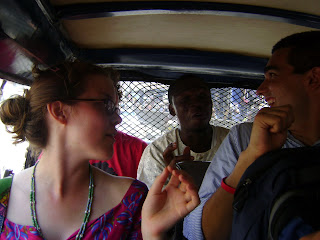
[a tro-tro ride...]
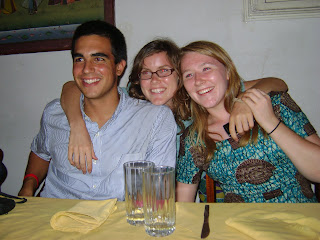
We strolled down Oxford Street, the focus of activity in Osu, until we reached Haveli's Indian restaurant, which had been recommended to us by Kathleen's friend from work. Not quite sure what to expect as a couple of Americans entering an Indian restaurant in a part of Ghana known for being frequented by oborunis (foreigners), we nevertheless filed in. No one else was in the restaurant, which was warm and authentically furnished with the lights slightly dimmed, and as we were shown to our seats at a table appropriate for a banquet but slightly imposing for a group of five, our waiter obligingly switched on the air conditioning for us. After perusing the menu we ordered, chatted, and awaited what proved to be a delicious--if eclectic--Thanksgiving dinner. Each of us shared a few things we were thankful for, and though our gratitude was spread widely, all of us seemed to be thankful for, in addition to the unique things, similar things: our families and those supporting us during this year, and the incredible privilege that each of us has to be in Ghana.
[Nick, Kathleen, and I at Thanksgiving dinner...]
Following dinner we met Yaw and Clara, our incredible program directors, for ice cream before taking the long tro-tro ride back home. As soon as I arrived at my house to find everyone asleep, I called my family back in the U.S., and was fortunate to get to talk with my parents, my brothers, and almost my entire Dad's side of the family: the perfect end to a day of thanksgiving!
The next morning the five of us, along with Yaw and Clara, set out for a five-day vacation to the Volta Region, the easternmost part of Ghana, which borders Togo. I won't offer you a travelogue on a day-by-day basis, but I can assure you that it was everything a vacation should be: fun, exciting, relaxing, and wonderful! Being able to be instantly understood when speaking English at my typically rapid rate and with the usual idioms was a simple change from my daily life in Accra, but even that capability was a welcome freedom. We simply had a fantastic time. Let me share a couple of pictures with you:
[learning to weave kente...]
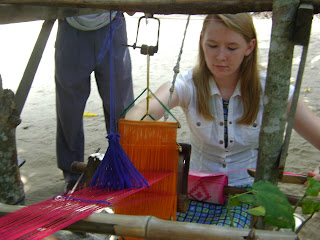
We learned how the Ewes, the primary group of people who live in the Volta Region, weave kente cloth by observing some very skilled weavers and then trying our suddenly clumsy hands at it. The cloth is woven into strips a few inches across and then created by sewing about twenty strips of cloth together to make a large piece of fabric. The Ashantis of central Ghana (who speak Twi and are the primary residents of Kumasi, the capital of the Ashanti Region, where I will be moving in about a month) also weave kente, but Ewe kente differs in its patterns.
[dressed for the shrine: Kathleen, Cole, Nick, Clara, me, Aria, and Kwakukye, our gracious Ewe-speaking guide for the weekend...]

Though a shrine is not somewhere I would go on my own, visiting briefly was an interesting cultural experience. We met the chief priest and the chief priestess as well as a group of drummers and musicians who performed traditional music and dances before we were given the chance to ask a few questions. The particular shrine we visited claims to worship one supreme being through the vessel of a lesser deity called Tobia Awia (which may not be spelled correctly?) who communicates directly with the chief priest. We were not allowed to wear our usual clothes or shoes to the shrine as doing so is a taboo.
[dancing agbodje, a traditional Ewe dance...]
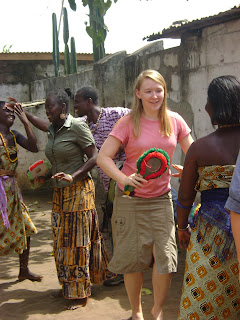
Some weeks ago we took a lesson in this traditional style of dance, characterized by vigorous shoulder movements slightly akin to flapping like a bird, and the lesson has come in handy on many occasions when we have been called upon to perform! The dance is a war dance, depicting a battle, but it is performed at almost any community events, from weddings to funerals to festivals and anything in between. Our skills are certainly improving!
[the beach...]
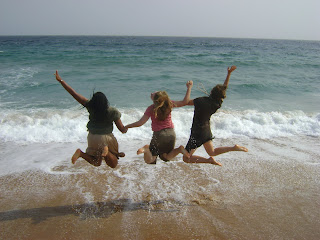
On the last day of our vacation we spent a little time at the beach, which was positively amazing. I think no further explanation is needed :)
And so, friends, I have much to be thankful for every day. As I begin my last month in Accra, I am overwhelmed to think that already my time in Ghana is 1/3 over, but when I look back at the last three months, I am stunned by gratitude. Surely, God is good!
Love to all, and my thanks as always for reading and caring!
Jessica
It's been a while. Are you healthy, and happy? How is life treating you? Has it been well? Let me tell you now, before you read any further: I am thankful for you!
I have just returned from vacation, and being away reminded me of just how incredibly thankful I am for so many things--your support among them! But let's begin back when it was still November, on Thanksgiving Day to be exact...
As you might imagine, I had quite the atypical Thanksgiving. It began early as usual, with a refreshing bucket bath to start off the morning. I had planned to meet Kathleen and Aria (my Ghana sisters and fellow Princeton Tigers class of '14) for a trip to Makola market, a sprawling region of Accra where you can buy just about anything that the average person in Ghana would need, that morning, and so I hustled to catch a tro-tro to meet them. At Makola we hoped to explore and do a bit of preliminary Christmas shopping before meeting up with our Ghana brothers, Cole and Nick, to see a movie at the mall and then venture out for our version of Thanksgiving dinner. Though assailed by unidentifiable scents and occasionally distracted by a stray chick underfoot, the three of us ventured through the cramped isles between stalls. Having dressed for the celebratory occasion in African garb, women in the market called out to us: "Akosua, wo ho yε fε paa!" / "[Generic name for any white lady, but specifically an Akan/Ashanti woman born on a Sunday], you look very beautiful!" Some stopped us and asked our names, others tried very forcefully to sell us shea butter, and others just laughed appreciatively when we told them, in Twi, that we were from America but had been in Ghana for three months. Makola was hectic, it has sweaty, it was friendly, and it was overwhelming.
We wandered about, greeted and haggled in Twi, avoided being hit by renegade taxis, and eventually emerged to purchase a massive mango with a pineapple to accompany it as a noontime snack. While it was obvious that we were still quite conspicuous and, in the eyes of many of the people we passed, a little of an oddity in a typical Ghanaian market, I was not greatly bothered by this. I realize that going to the market was exciting for me in a way that it probably never will be for the thousands of people who go there daily, who don't have the alternatives to this teeming human hub that I do, who can't just wait another six months to go back to the US or have something mailed from there to here if they can't find it at the market, who might not even have the option of going to a chain store like ShopRite at the Accra Mall when they want a little less chaos. And yet, though I and most of the Ghanaians at Makola don't share the same experience when we go there, the sights we see are the same, and so are the smells, the sounds. Like most things I do in Ghana, I will never do them quite the same as Ghanaians do or experience them in quite the same way, but the mere fact that I am experiencing them and grappling with them is significant and important, and I am thankful for the opportunity to do so.
After leaving the market, succulent mango and sweet pineapple in hand, we caught a tro-tro to the Accra mall, a location which embodied the difference between my Ghana life and that of many of the Ghanaians I met in the market. Of course, plenty of Ghanaians frequent the mall, and some shop for groceries almost exclusively at ShopRite--after all, the Accra mall is a fairly ritzy place, especially in comparison with Makola market, but it is not only for foreigners. However, the distinction between the market where average Ghanaian shops and the mall where we now found ourselves was striking. Humbled, I was thankful for the incredible and undeserved privileges I have been granted and reminded not to take them for granted.
Aria, Kathleen, and I met up with Cole and Nick at the mall, and after obtaining the movie schedule, selecting a movie, finding out it was not actually playing as per the schedule, settling for our second choice, and spending a few hours in the theater absorbing the film, the five of us gathered our belongings and headed first by tro-tro and then by a very cramped taxi to Osu for Thanksgiving Dinner.
[a tro-tro ride...]

We strolled down Oxford Street, the focus of activity in Osu, until we reached Haveli's Indian restaurant, which had been recommended to us by Kathleen's friend from work. Not quite sure what to expect as a couple of Americans entering an Indian restaurant in a part of Ghana known for being frequented by oborunis (foreigners), we nevertheless filed in. No one else was in the restaurant, which was warm and authentically furnished with the lights slightly dimmed, and as we were shown to our seats at a table appropriate for a banquet but slightly imposing for a group of five, our waiter obligingly switched on the air conditioning for us. After perusing the menu we ordered, chatted, and awaited what proved to be a delicious--if eclectic--Thanksgiving dinner. Each of us shared a few things we were thankful for, and though our gratitude was spread widely, all of us seemed to be thankful for, in addition to the unique things, similar things: our families and those supporting us during this year, and the incredible privilege that each of us has to be in Ghana.
[Nick, Kathleen, and I at Thanksgiving dinner...]

Following dinner we met Yaw and Clara, our incredible program directors, for ice cream before taking the long tro-tro ride back home. As soon as I arrived at my house to find everyone asleep, I called my family back in the U.S., and was fortunate to get to talk with my parents, my brothers, and almost my entire Dad's side of the family: the perfect end to a day of thanksgiving!
The next morning the five of us, along with Yaw and Clara, set out for a five-day vacation to the Volta Region, the easternmost part of Ghana, which borders Togo. I won't offer you a travelogue on a day-by-day basis, but I can assure you that it was everything a vacation should be: fun, exciting, relaxing, and wonderful! Being able to be instantly understood when speaking English at my typically rapid rate and with the usual idioms was a simple change from my daily life in Accra, but even that capability was a welcome freedom. We simply had a fantastic time. Let me share a couple of pictures with you:
[learning to weave kente...]

We learned how the Ewes, the primary group of people who live in the Volta Region, weave kente cloth by observing some very skilled weavers and then trying our suddenly clumsy hands at it. The cloth is woven into strips a few inches across and then created by sewing about twenty strips of cloth together to make a large piece of fabric. The Ashantis of central Ghana (who speak Twi and are the primary residents of Kumasi, the capital of the Ashanti Region, where I will be moving in about a month) also weave kente, but Ewe kente differs in its patterns.
[dressed for the shrine: Kathleen, Cole, Nick, Clara, me, Aria, and Kwakukye, our gracious Ewe-speaking guide for the weekend...]

Though a shrine is not somewhere I would go on my own, visiting briefly was an interesting cultural experience. We met the chief priest and the chief priestess as well as a group of drummers and musicians who performed traditional music and dances before we were given the chance to ask a few questions. The particular shrine we visited claims to worship one supreme being through the vessel of a lesser deity called Tobia Awia (which may not be spelled correctly?) who communicates directly with the chief priest. We were not allowed to wear our usual clothes or shoes to the shrine as doing so is a taboo.
[dancing agbodje, a traditional Ewe dance...]

Some weeks ago we took a lesson in this traditional style of dance, characterized by vigorous shoulder movements slightly akin to flapping like a bird, and the lesson has come in handy on many occasions when we have been called upon to perform! The dance is a war dance, depicting a battle, but it is performed at almost any community events, from weddings to funerals to festivals and anything in between. Our skills are certainly improving!
[the beach...]

On the last day of our vacation we spent a little time at the beach, which was positively amazing. I think no further explanation is needed :)
And so, friends, I have much to be thankful for every day. As I begin my last month in Accra, I am overwhelmed to think that already my time in Ghana is 1/3 over, but when I look back at the last three months, I am stunned by gratitude. Surely, God is good!
Love to all, and my thanks as always for reading and caring!
Jessica
Subscribe to:
Posts (Atom)